
Study Around:
An Inclusive Library Reservation App

During the COVID-19 pandemic, UW-Madison libraries implemented multiple restrictions for entry. Everyone who tried to enter any school building must make an appointment. There are more than 25 libraries at UW-Madison and they have separate booking systems, causing inconveniences when users are trying to find a place to study. I wanted to challenge myself and create a problem-solving design in a week. This is a side project done on my own.
The primary goal of the app design is to foster a seamless reservation experience across all libraries at UW-Madison and ensure it is catered to various users who have different needs and preferences to find a study location with minimal effort.
How might we...
... foster an inclusive library reservation experience?
Problem Statement
There are more than 25 libraries at UW-Madison and they have separate booking systems, it is difficult to find a study space, not to mention finding one that matches individuals' preferences. Lots of users didn't know the school put on restrictions during COVID. Furthermore, libraries put on limited hours, how do we ensure users maximizing productivity, especially those who relied on library resources?
Design Goals
1. An easy-to-use all-in-one experience that users can complete tasks on the go with minimal effort.
2. Provide an experience to streamline the library appointment reservation process during COVID while fulfilling the needs of the school library’s users.
3. Efficiently deliver useful information to users that would boost their academic productivity.
Discovery
Understanding user needs represents the first step in developing a human-centered product. Due to this project's time limitation, I conducted the following research methods to identify what needs to be improved in the process.
5 Interviews (students & faculty),
20+ Survey,
Examined current system,
Analogous Inspiration

Research Takeaways
1. Everyone has their preferences in choosing the study environment, but the system doesn’t give users the flexibility to do so.
2. Not knowing the schedule of the room/space has caused users countless waiting experiences.
3. 85% of the interviewees mentioned devices in the study room and resources nearby are the key to their decision-making.
4. 20% of the participants didn’t know the COVID-19 test is required to enter the UW-Madison library or other policy in place.
Discovery
Persona & User Journey
After clustering the data, with the help of and mind map, we can easily identify the main needs of our users and sketch out a user journey map with quotes from the interviews. Together, we used persona and user journey throughout our design process to guide design decisions, priorities, and create empathy.
Design Process

Initial Concepts


Refined Concepts
We couldn't decide which concepts to move forward as they are all very different. We then agreed on refining the concepts that reflect our core users' needs which is a commonly touched surface - door latch and handle. We walked through the same process of divergent and convergent thinking. Furthermore, we created storyboards for the concept product testing (CPT) with users we interviewed.


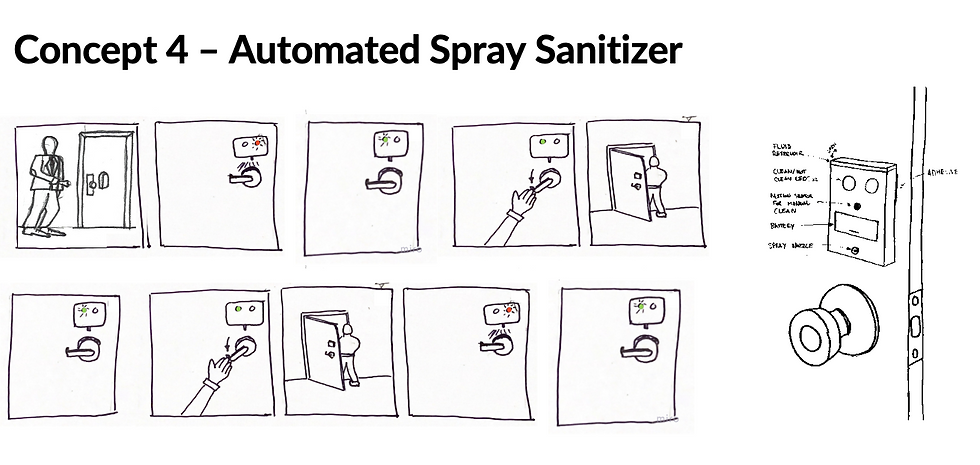
We decided to move forward with the Automated Door Latch, because it is the most desirable concept with 95% of participants indicated they are willing to use it every time to enter/exit the door.
“Good because hands might be occupied, so it's very convenient! The concept could be used after COVID too."
Version 1 Mock-up


Iteration - Jham Latch
The ideation phase included brainstorming, divergent thinking and convergent thinking.
The JHAM Latch provides a touch-free means of opening the door when used in combination with the foot or forearm pull devices. Every time the door is used, the touch prevention counter increases, giving the user a sense of comfort knowing they both prevented themselves from touching a surface that a certain amount of people have touched as well as preventing the spread of the virus to their coworkers.
Intuitive Experience
Design Decision #1
Motion Sensing
The motion sensor icon on the left conveys to the user that the device is motion-activated. The sensor on the front can be triggered by holding your hand in front of the sensor or by standing in front of it.

Design Decision #2
Showing the progress of opening latch
As the motion is detected, the green light progress bar grows, showing the users visually that their request is known and being completed. This ensures they open the door once the latch is open as well as they know the motion sensor is working.

Human Factors
Design Decision #1
The collapsible and expandable doorknob design avoids users’ natural behaviors of touching the doorknob.
The design features an extendable door handle. The handle extends outward when pushed in and when turned, manually opens the door latch. This encourages the use of the motion sensor and prevents users from grabbing the doorknob to open the door. Additionally, the knob provides the means to open the door in case of an emergency.

Traction


Takeaways
It was my first time working on a hardware product design. There were many different things to consider in terms of user experience. I took the lead in design research and my teammates relied on my expertise in user experience. It was an interesting experience to work with mechanical engineers and electrical engineers. Because they had little background in product design and not to mention using the design thinking method in product design.
Internal communication drove the project! At the beginning of the project, we had a hard time reaching a consensus. Old-school engineers tend to jump to conclusions or directly jump to solutions instead of going through the research and ideation process. Through constant communication and encouragement of thinking from a UX standpoint, it took me quite some effort to finally be on the same page with them. It is easier to speak their language instead of asking them to understand your jargon.