
OK2Take:
Prohibited Medication Search for LQTS Patient

Long QT Syndrome (LQTS), a dangerous heart rhythm disorder that can cause chaotic and sometimes fatal heartbeats, are instructed to avoid certain medications as the first line of defense against fainting, seizures, and, in extreme cases, sudden death. The list of prohibited medications is close to 300 items, which makes it impossible for anyone person to know without assistance what drugs are safe to take. LQTS may be expected to occur in the range of 1 in 2,000 individuals.
Unsearchable medication list
Until recently, individuals had only a PDF from Credible Meds, arranged in alphabetical order by generic drug name, from which to determine whether or not a drug was dangerous for people with LQTS. This list was not searchable and resulted in a system that posed significant risks to the patients.
The only system
There is only one system in the market now (CredibleMeds) is a mobile app for medication search. It only allows users to search the exact medication name and lacks efficiency or a clear definition of the risks imposed.
Hence, Ok2Take was born out of the desire to help individuals with Long QT Syndrome safely buy and take over-the-counter medications.
Role
Research, UX Design
Duration
3 months
Process
Survey, secondary research, competitive analysis, system analysis, user journey, wireframing, prototyping, and usability testing
Teammates
Anna Simonson (Project Manager) Dan Wu (Operations)
Olivia Fountaine (Tech lead)
Problem Statement
How might we assist LQTS patients to efficiently find the medication they are safe to take?
User story
As a LQTS patient who often goes to the pharmacy to get medicines for her flu, Ashton wants a searchable and easily accessible of her prohibited medication list, so that she can find the medications that need to be avoided or safe in a short time, instead of spending 30 minutes to cross-reference in a drug store.
How might we provide a tailored experience that allows users to easily access the information they need?
User story
As a pharmacist who doesn't know much about Long QT Syndrome, Daniel wants a digital product that he can thoroughly get the information he needs for his patients so that he can ensure his work is not putting them at risk.
Discovery
Talking to users
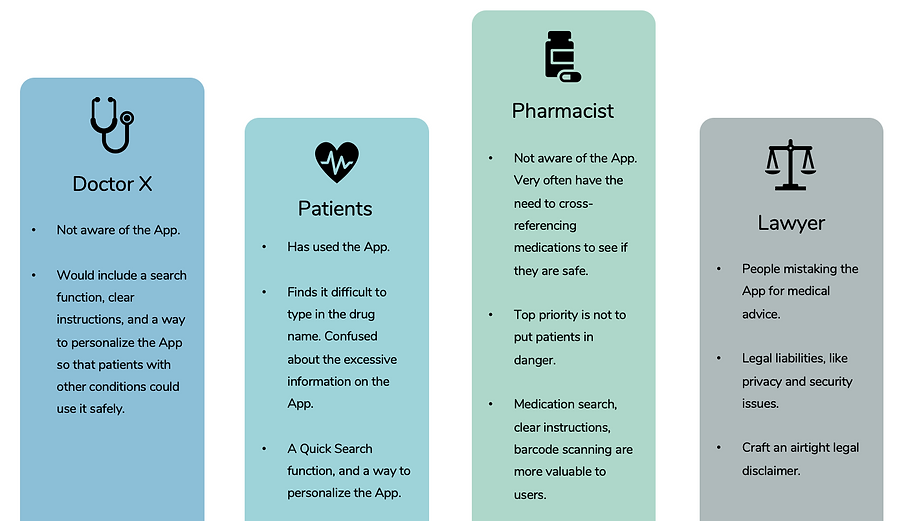
We conducted a survey and interviews to collect both quantitative and qualitative data with our stakeholders, including LQTS patients, pharmacists, and physicians to understand their needs and goals during medication search, as well as the unspoken underlying needs. Furthermore, we asked users to accomplish tasks on the current system to identify what the current system lacks and how can we create a product that delivers the most intuitive experience and best assists the users.
Design Goals
What should be done?
1. Create several ways to look up medications
2. Present the complex information in a clean way for different types of users
3. Allows users to personalize for a tailored experience
4. Provide clear instructions to users regarding medication without confusion.
Design Process
The ideation phase is based on translating key observations and opportunities into actionable solutions. I led our team with several brainstorming sessions and created wireframes and low fidelity prototype to pitch the project sponsor.


Ideation of features was based on the needs and goals summarized in each phase of the user journey. After receiving the approval of moving forward with low-fidelity prototypes, we moved on to work on high-fidelity prototypes. I created the user flow of the app to showcase to the stakeholder as part of the presentation.

Making Tasks Manageable


Customize for
Efficiency
Problem Statement
The user that likes to note down everything needs the ability to save his medications because it would not be efficient to search the medication every time.
Design Decisions
#1
While it’s important to avoid certain medications, one of the more difficult things for people with LQTS is determining what medications they can take. People are unique, their LQTS conditions are also based on individuals. The feature of allowing users to add their own "OK2Take List" helps users to quickly find the medications they can take.
#2
Making the product personalized that users can create their own lists with different medications for different conditions through saving the med records.

Visual Confirmations
Design Decisions
#1
A function that highlights any changes to the medication list is the first thing the users see when they open the app, which would help users avoid overlooking something due to regular use.
#2
Adding colors for users to differentiate if the medication is safe to take or not.

Problem Statement
The user is a 50-year-old LQTS patient with the highest degree from high school who needs to quickly identify if she can take the medication or not and because taking the wrong medication could risk her life.
Design Decisions
#1
Barcode scanning allows users to quickly scan the barcode when they're in pharmacies. The function would significantly benefit users in terms of saving time, ensure accuracy, and decrease the mis-spelling risk that patients might buy or take something dangerous.
#2
Sorted the medications into common categories, e.g. flu, stomach, etc. that users who are not medical professionals can easily comprehend. Users can use the app to search the over-the-counter medications that they need to avoid beforehand when they have the symptoms.
#3
Only providing the information that is the most essential to the users. There are multiple pieces of information that are crucial for medical professionals regarding the medication. However, they are less important for users, to avoid cognitive overload, we adopted collapse and expand pattern to hide the information that cannot be omitted.
The MVP
Validation
After showing the MVP to 2 LQTS patients and 1 pharmacist, the OK2Take app received comments as follow,
"I need this, when is this going to the market?"
“Please continue to work on this which will be a great contribution to the LQTS community.”
Next Step
Due to the project's time limitation, we didn't have time to conduct a usability test and iterate the design. However, consider the feedback received that it would greatly contribute to the LQTS community, I've decided to continue working on this as my side project in 2021.
The ultimate goal is to pitch the design to Credible Meds by Q2 2021. If you are interested in joining the project, please don't hesitate to let me know. I'll be more than happy to share more information with you.
Takeaways
Consider legal liability in product design
Our team considered HIPAA compliance but didn’t consider putting the legal liability disclaimer until our sponsor reminded us. This is especially crucial in medically related services as it could put users' lives at risk.